
SEO practices have been changing significantly during the past few years. Thus, in 2026, the publication of keyword-based articles will not be sufficient. Modern search engines assess the ability of your site to provide information about the full topic rather than pages individually. It is why the development of a Topical Authority Map can be considered one of the best SEO practices.
Topical Authority Maps allow organizing your website in structured clusters that prove your expertise, optimize internal linking, and become beneficial for search engines to comprehend your website. In case your purpose is to rank your website in the first place and receive quality traffic, you need to pay attention to the creation of content clusters.
What Is a Topical Authority Map?
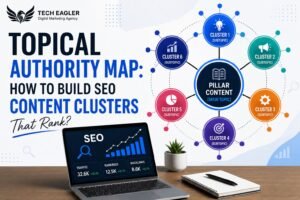
Topical Authority Map is a content strategy that consists of articles about the same subject matter. Unlike the approach of publishing individual articles based on keywords, you create a cluster of articles related to one subject matter.
For instance, if you create a website that provides information regarding SEO, then your guide can become Technical SEO Guide and your supporting articles can be:
* Core Web Vitals Explained
* XML Sitemap Best Practices
* Canonical Tags
Step 1: Choose Your Core Topic
Every topical authority map begins with one broad subject.
Choose a topic that closely matches your business, services, or audience. Avoid creating clusters around subjects that are unrelated to your expertise.
For example:
* SEO
* Digital Marketing
* Cybersecurity
* Email Marketing
* Web Development
* Artificial Intelligence
The broader topic becomes your pillar page.
Step 2: Find Supporting Subtopics
After selecting the main topic, brainstorm every related question your audience might ask.
Think beyond keywords. Focus on problems people want to solve.
For an SEO website, supporting topics might include:
* On-Page SEO
* Off-Page SEO
* Local SEO
* Programmatic SEO
* AI SEO
* Link Building
* Keyword Research
* Schema Markup
* Content Optimization
* SEO Audits
Each of these can become its own article connected to the main pillar page.
Step 3: Formulate Logical Content Clusters
One such mistake is creating multiple articles that have no connections among them.
Instead, create content as if you are forming a tree.
Pillar Page
↓
Topic Cluster
↓
Articles
↓
Guides
↓
Case Studies
↓
FAQs
That way, users can get navigation ease, not to mention allowing search engines to figure out the connection between the different pages.
Step 4: Create Good Internal Links
Internal links create the foundation for topic authority.
All support posts need to link back to the pillar post, where necessary. On the other hand, the pillar post needs to refer the user to the support posts.
Linking should not be done simply because of SEO. Every internal link needs to add value for the reader.
An interconnected website makes users stay longer within your site as well as makes search engines crawl your web pages.
Step 5: Address Search Intent, Not Just Keywords
Many websites still write articles purely around keywords.
SEO in 2026 will focus on the search intent of users.
Ask yourself:
* What issue is the user trying to solve?
* What information is he/she seeking?
* What additional queries will he/she have?
The minute you answer all these queries in the article naturally, its worth becomes much more valuable than that of the one already created merely due to keywords.
User-centric approach meets the criteria of Google’s Helpful Content.
Step 6: Continue Updating Your Content
Once creating a piece of content is not enough.
Search intent, search algorithm updates, and industry trends keep changing. Check your old posts to:
* Update outdated statistics
* Add new examples
* Improve screenshots
* Expand sections
* Refresh internal links
* Include emerging trends
The existence of fresh and accurate content demonstrates that your site is still up-to-date and credible.
Common Errors to Be Avoided
Many websites do not develop topical authority since they:
* Produce duplicate content
* Use almost similar keywords on different pages
* Ignore internal linking
* Create thin articles with little value
* Focus only on search engines instead of readers
Making such mistakes will negatively affect your content.
How AI Search Influences Topical Authority
As more and more AI search engines evolve, the ability to show expertise becomes more important. Such engines are focused not on matching particular keywords but rather the way in which a website explains a particular topic through different related pieces of content.
That’s why sites that have content clusters become more likely to be included into AI answers, featured snippets, and conversational searches.
Today building topical authority is not only about Google rankings. You should become a credible source of information in the changing search ecosystem.
Conclusion
It’s no longer possible to grow organically if your website does not have topical authority. Creating a content cluster strategy will help search engines see your expertise while making users’ experience on your site better thanks to the structure of the content you provide.
In 2026, sites which show their authority in one particular topic in general will outrank sites using blogs in isolation. With the implementation of topical authority mapping in your website, you will not only build a better SEO foundation but also get traffic for years to come.